
Overview of 2024 Zoonoses Data
Introduction
Zoonoses refer to diseases and infections that can be transmitted between animals and humans. Transmission may occur through direct contact with animals or indirectly via exposure to animal excreta, such as faeces, which can contaminate food, water, or the environment. Foodborne zoonotic diseases arise from the consumption of food or water that has been contaminated with zoonotic pathogens, including bacteria and their toxins, viruses, and parasites. These pathogens typically enter the body through the gastrointestinal tract, where initial symptoms often manifest. Many of these microorganisms are found in the intestines of healthy food-producing animals. The potential for contamination exists throughout the food chain from the farm to the consumer. This necessitates effective prevention and control measures at every stage of the food chain. While anyone can be infected by a zoonotic pathogen, certain populations, particularly young children, the elderly, and individuals with compromised immune systems are more vulnerable and face a higher risk of severe health outcomes.
The control and elimination of zoonoses in humans and animals presents challenges. However, the impact of zoonoses on health can be mitigated through: (i) monitoring the reservoirs of infectious zoonotic pathogens to better understand and manage their transmission; (ii) implementing hazard control measures along the food chain by businesses; and (iii) providing public education aimed at reducing the risk of infection.
The European Union (EU) Zoonoses Directive (Directive 2003/99/EC) requires Member States to collect data on zoonoses. The Directive requires reporting at EU level on eight zoonoses (i.e. List A, Annex I) with reporting on additional zoonoses based on the epidemiological situation in the Member State (i.e. List B, Annex I). Annual EU summary reports are jointly published by the European Food Safety Authority (EFSA) and the European Centre for Disease and Prevention Control (ECDC). The latest report, at time of publication, is for the 2023 data (EFSA and ECDC, 2024).
Ireland’s national zoonoses report is published annually by the FSAI, in collaboration with the Department of Agriculture, Food and the Marine (DAFM), the Health Service Executive (HSE), the Local Authority Veterinary Service (LAVS), the Sea-Fisheries Protection Authority (SFPA) and the Health Protection Surveillance Centre (HPSC). The report brings together the results of thousands of tests carried out on samples of food and feed, as well as tests on material of animal or human origin, in an effort to determine the pattern and extent of infection by zoonotic pathogens transmitted to humans from animals.
Please be advised that the human zoonoses figures for 2024 are provisional and may be revised in the subsequent years. This is due to ongoing updates based on the notification data in the HPSC’s Computerised Infectious Disease Reporting (CIDR) system.
The data presented in the 2024 tables concerning the results of testing conducted in Ireland on food, animal, and animal feed samples is categorised into four distinct types: routine, census, objective, and suspect sampling (EFSA, 2024):
Routine sampling is considered as planned sampling, though it does not utilise statistically random methods.
Census sampling refers to the comprehensive assessment of an entire population on which the data is based.
Objective sampling involves the deliberate selection of a random sample that is statistically representative of the population under analysis.
Suspect sampling is an unplanned approach where individual units are chosen based on recent judgment and experience related to the population, lot, or sampling frame, such as prior positive samples. The samples obtained from suspect sampling may have a higher likelihood of having pathogens present.
Overview of 2024 data
Brucellosis
- In Ireland, there was 1 notified case of brucellosis in 2024, resulting in a crude incidence rate (CIR) of 0.02 per 100,000 population (HPSC, 2024). This disease ranked joint eleventh in terms of incidence among the various zoonotic diseases reported.
- During 2024, a total of 106,166 bovine herds, and 42,530 ovine and caprine herds, were tested for the presence of Brucella. None of the herds were identified as infected. All herds were classified with the status of being officially free from the disease.
- In addition to the bovine, ovine and caprine herds tested, a total of 1,263 animal samples were tested in Ireland. None of the tested samples were positive for Brucella.
Campylobacteriosis
- In Ireland, a total number of 3,984 reported cases of human campylobacteriosis were reported in 2024, equating to a CIR of 74.05 cases per 100,000 population (HPSC, 2024). This disease ranked first in Ireland in terms of incidence compared to the other zoonotic diseases reported.
- During 2024, a total of 190 routine food samples (meat n=187; other foods n=3) and 57 suspect food samples (meat n=30; other foods n=27) were tested for the presence of Campylobacter spp. Campylobacter was detected in:
- 127 (67.9%) of the 187 routine meat samples. Positive samples were obtained from broiler carcases (n=124), poultry carcases (n=2) and from fresh broilers (n=1).
- During 2024, a total of 1,724 animal samples were tested for Campylobacter, 158 of which were positive (9.2%). Infected animals included calves under one year of age (n=134) and sheep (n=24).
Cryptosporidiosis
- In Ireland, there were 640 reported cases of cryptosporidiosis in 2024, resulting in a case incidence rate (CIR) of 11.9 per 100,000 population (HPSC, 2024). This disease recorded the third highest incidence compared to the other zoonotic diseases reported.
Echinococcosis
- In Ireland, there were 3 reported cases of echinococcosis in 2024, resulting in a CIR of 0.06 per 100,000 population (HPSC, 2024). This disease ranked tenth in terms of incidence among the various zoonotic diseases reported.
Leptospirosis
- In Ireland, there were 16 notified cases of leptospirosis in 2024, resulting in a CIR of 0.83 per 100,000 population (HPSC, 2024). This disease ranked eighth in terms of incidence among the various zoonotic diseases reported.
Listeriosis
- In Ireland, there were 22 notified cases of listeriosis in 2024, resulting in a CIR of 0.41 per 100,000 population (HPSC, 2024). This disease ranked seventh in terms of incidence compared to the other zoonotic diseases reported.
- During 2024, a total of 153 routine meat samples and 107 routine samples from other foods, as well as 24 suspect meat samples and 48 suspect samples from other foods, were tested for the detection of L. monocytogenes. L. monocytogenes was not detected in any routine meat samples or routine samples from other foods. However, it was detected in 4 suspect pork meat samples (16.6%) and 7 suspect samples from other foods (14.5%), which included:
- Bakery products (n=1)
- Smoked fish (n=6)
- For enumeration tests, a total of 1,054 routine meat samples, 897 routine samples from other foods, 44 suspect meat samples, and 144 suspect samples from other foods were tested.
- L. monocytogenes was enumerated from 2 routine meat samples (0.19%), 2 routine samples from other foods (0.22%), 1 suspect meat sample (2.27%), and 7 suspect samples from other foods (4.86%).
- Of the 2,139 enumeration tests, L. monocytogenes was present in none of the samples at >100 cfu/g, which is the legal limit set by Commission Regulation (EC) 2073/2005 for certain RTE foods during shelf life. The highest reported count was 70 cfu/g in sliced bacon. The other results were sliced bacon (70 cfu/g), an unspecified chicken dish (< 40 cfu/g), cooked ham (10 cfu/g), chicken and stuffing sandwich (40 cfu/g), and cooked chicken (40 cfu/g).
- During 2024, a total of 6,048 animal samples were tested for L. monocytogenes, 53 of which were positive (0.87%). Infected animals included cattle (n=41) and sheep (n=12).
Q fever
- In Ireland, there was 1 reported case of Q fever in 2024, equating to a CIR of 0.02 cases per 100,000 population (HPSC, 2024). This disease ranked joint eleventh in terms of incidence compared to the other zoonotic diseases reported.
- During 2024, a total of 1,442 animal samples were tested for the presence of Coxiella. Coxiella was detected in 32 samples. These included:
- 31 (2.7%) of 1,147 dairy cows,
- 1 (0.4%) of 285 sheep.
Salmonellosis
- In Ireland, a total of 391 cases of salmonellosis were reported in 2024, equating to a CIR of 7.27 cases per 100,000 population (HPSC, 2024). This disease ranked fourth in terms of incidence compared to the other zoonotic diseases reported.
- During 2024, a total of 2,699 routine food samples (meat n=598; other foods n=2,101) and 220 suspect food samples (meat n=67; other foods n=147) were tested for the presence of Salmonella spp. Salmonella was detected in:
- 17 (2.8%) of the 598 routine meat samples. The positive samples included carcases from cows (n=1) and broilers (n=4), fresh meat from broilers (n=3) and meat preparations from mixed species (n=1), pigs (n=5), retail meat products (n=1), minced turkey meat (n=1) and offal (n=1).
- 1 (1.5%) of the 67 suspect meat samples. The positive sample originated from a raw meat from other animal species or not specified.
- A total of 62 Salmonella isolates were detected in all food samples tested. The most prevalent serovars included S. Braenderup (13 isolates), S. Typhimurium (5 isolates), and smaller numbers of other serovars such as S. 3,12:i:- (4 isolates), S. Brandenburg (4 isolates), S. 6,7:3,h:- (3 isolates), S. Derby (2 isolates), S. Enteritidis (1 isolate), S. Kentucky (1 isolate), S. Mbandaka (1 isolate), S. Schwarzengrund (1 isolate), and S. Tennessee (1 isolate). Additionally, 18 isolates were classified as unspecified species, and 8 isolates were not typable.
- During 2024, a total of 7,479 animal samples were tested under objective (n=6,184) and suspect (n=1,295) sampling for the presence of Salmonella. Salmonella was detected in 106 samples. Of official sampling, these included:
- 29 (2.3%) of 1,255 sheep,
- 18 (8.5%) of 212 pigs,
- 33 (2.5%) of 4,361 adult cattle over 2 years of age,
- 1 (11.1%) of 9 ducks.
- 1 (1.3%) of 76 hens.
- Of suspect sampling, these included:
- 24 (1.9%) of 1,295 aborted calves,
- In addition, poultry flocks were tested for Salmonella under industry (census) sampling and under official (objective) sampling in 2024. Of official sampling:
- 119 broiler breeder flocks of Gallus gallus (parent breeding flocks) were tested with no positive flocks,
- 33 broiler flocks before slaughter were tested with 1 positive flock (3.0%),
- 364 laying adult hens were tested with 1 positive flock (0.3%),
- 5 turkey breeders (parent breeding flocks) were tested with no positive flocks,
- 10 turkey fatteners before slaughter were tested with no positive flocks.
- Of industry sampling:
- 119 broiler breeder flocks of Gallus gallus (parent breeding flocks) were tested with 1 positive flock (0.8%),
- 4,339 broiler flocks before slaughter were tested with 5 positive flocks (0.1%),
- 464 laying adult hens were tested with 1 positive flock (0.2%),
- 5 turkey breeder flocks were tested with no positive flocks,
- 455 turkey fatteners before slaughter tested with 3 positive flocks (0.7%).
- During 2024, a total of 507 animal feed material was tested for the presence of Salmonella. One of the animal feed materials in the category feed material of oil seed or fruit origin tested positive for Salmonella, 0.7% of the 150 samples tested in this category.
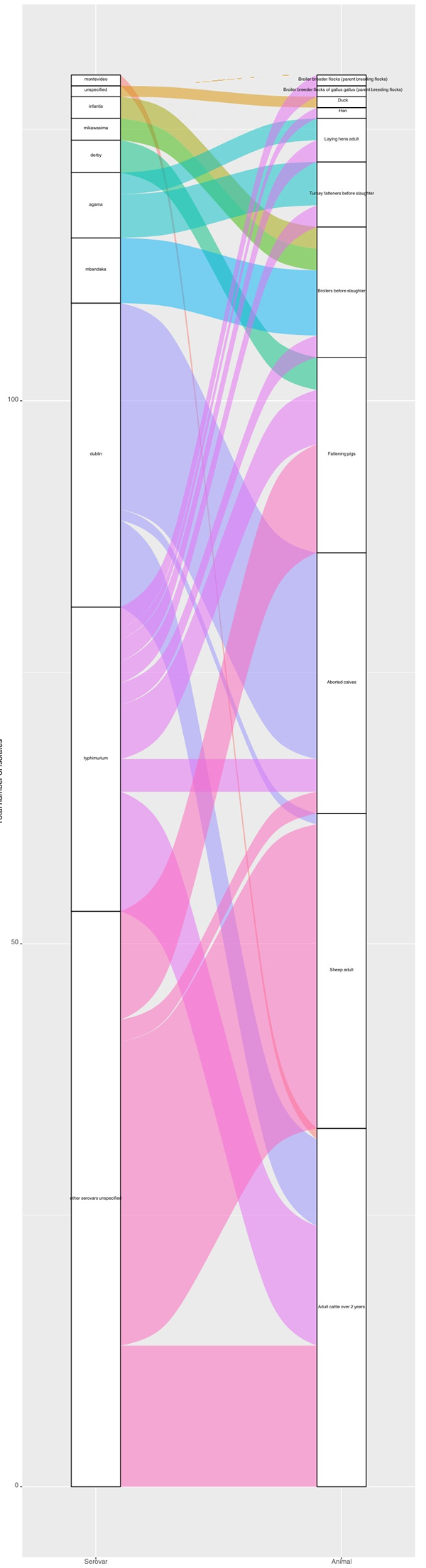
Figure 1 Sankey diagram depicting the relationship of Salmonella serovars with various animal species tested in 2024.
Trichinosis
- In Ireland, there were no reported cases of trichinosis in 2024 (HPSC, 2024).
- During 2024, a total of 3,325,030 tests carried out for Trichinella in horses (n=939) and pigs (n=3,424,091), with no positive samples detected.
Toxoplasmosis
- In Ireland, there were 14 notified cases of toxoplasmosis in 2024, resulting in a CIR of 0.26 per 100,000 population (HPSC, 2024). This disease ranked ninth in terms of incidence compared to the other zoonotic diseases reported.
During 2024, a total of 324 animal samples were tested for the presence of Toxoplasma. Two (25%) of the samples obtained from 8 goat samples were positive, while 39 (12.6%) of the 310 samples obtained from sheep were positive for Toxoplasma.
Tuberculosis (TB)
- In Ireland, there were 288 notified cases of tuberculosis in 2024, resulting in a CIR of 5.35 per 100,000 population (HPSC, 2024). This disease ranked fifth in terms of incidence compared to the other zoonotic diseases reported. Globally, most cases of zoonotic TB are caused by M. bovis, and cattle are the major reservoir. At the time of publishing, the M. bovis human data was not available.
- During 2024, a total of 101,166 bovine herds were tested for the presence of mycobacterium, with 6,254 herds identified as infected. Furthermore, 102,094 herds were classified with the status of being officially free from the disease.
- In addition to the bovine herds tested, a total of 1,994 objective animal samples and 47 suspect animal samples were tested for the presence of Mycobacterium. Of the objective samples, 871 detections were observed. These included:
- 843 (43.3%) of 1,946 of badgers,
- 28 (58.3%) of 48 wild deer.
Of the suspect samples, 25 detections were observed. These included: - 4 (40%) of 10 fattening pigs,
- 3 (60%) of 5 cats,
- 16 (84.2%) of 19 alpacas, 2 (28.6%) of 7 adult sheep.
Variant Creutzfeldt-Jakob disease (vCJD), Bovine Spongiform Encephalopathy (BSE) and Transmissible Spongiform Encephalopathy (TSE)
- In Ireland, there were no reported cases of vCJD in 2024. The last reported case of vCJD occurred in 2006 (HPSC, 2024).
Verocytotoxigenic Escherichia coli (VTEC), also known as Shiga toxin-producing Escherichia coli (STEC)
- In Ireland, there were 796 notified cases of VTEC in 2024, resulting in a CIR of 14.79 per 100,000 population (HPSC, 2024). This disease ranked second in terms of incidence compared to the other zoonotic diseases reported.
- During 2024, a total of 121 routine food samples (meat n=92; other foods n=29) and 46 suspect food samples (meat n=13; other foods n=33) were tested for the presence of VTEC/STEC. None of the samples tested were positive.
Yersiniosis
- In Ireland, there were 40 notified cases of yersiniosis in 2024, resulting in a CIR of 0.74 per 100,000 population (HPSC, 2024). This disease ranked sixth in terms of incidence compared to the other zoonotic diseases reported.
- During 2024, a total of 6,671 animal samples were for the presence of Yersinia. Yersinia was detected in 14 samples. These included:
- 6 (100%) of 6 aborted calves,
- 3 (100%) of 3 calves under 1 year of age,
- 2 (0.04%) of 4,352 dairy cattle,
- 3 (0.2%) of 1,687 sheep under 1 year of age.
References
European Food Safety Authority (EFSA), 2024. Manual for reporting on zoonoses and zoonotic agents, under Directive 2003/99/EC, and on some other pathogenic microbiological agents for information derived from the year 2024. Available here: https://efsa.onlinelibrary.wiley.com/doi/pdf/10.2903/sp.efsa.2024.EN-7825
European Food Safety Authority (EFSA) and European Centre for Disease Prevention and Control (ECDC), 2023. European Food Safety Authority and European Centre for Disease Prevention and Control. The European Union One Health 2023 Report. Available here: https://www.ecdc.europa.eu/en/publications-data/european-union-one-health-2023-zoonoses-report
Health Protection Surveillance Centre (HPSC), 2025. Health Protection Surveillance Centre. Infectious Disease Notifications in Ireland, 2020 - 2024. Available here: www.hpsc.ie/notifiablediseases/annualidstatistics