
By law, food businesses must declare the presence of food allergens used as ingredients in their foods. Food allergen control should be part of the food safety management system. This includes food that is not prepacked. Staff training must include the identification and handling of the 14 allergens, as well as how to respond to consumer concerns.
Non-prepacked food includes:
- foods sold in loose form, e.g., foods sold in restaurants, delis, cafés, canteens, takeaways, butcher shops, retail outlets, etc.
- foods packed on the premises at the request of the consumer, e.g., a sandwich made and packed into a plastic triangle for the customer
- foods packed on the premises for direct sale to the consumer or mass caterer, e.g., lasagne made in a café kitchen and sold packaged from a fridge in the café.
What are the rules?
Food businesses must indicate food allergens in writing for non-prepacked food at the point of presentation, or sale, or supply. In Ireland, the information must:
- be provided in written form in English or in Irish and English
- be easily located and accessible before the sale or supply of the food - customers must have the information before buying and must not have to ask for the information
- relate directly to a food or beverage so there is no confusion about which food it relates to. It is not acceptable to say ‘Our food contains…’. You must identify the exact food, e.g., ‘spaghetti bolognaise - contains milk, celery, wheat’.
- be in a legible handwritten or printed format.
Food Allergen Management for Non-prepacked Food
Since 13 December 2014, the Food Information to Consumers (FIC) Regulation (EU) No. 1169/2011 has required allergen information to be declared on both prepacked and non‑prepacked food. In Ireland, this is implemented through S.I. No. 489 of 2014, updated by S.I. No. 656 of 2024. Under EU Regulation (EU) No. 1169/2011 – Food Information for Consumers (FIC), 14 specific allergens must be declared when used in the production or preparation of food and beverages.
-
Further information
Who do the rules apply to?
All food businesses handling allergens must declare them in both prepacked and non‑prepacked foods. This applies to:
- Restaurants, pubs, takeaways, contract caterers
- Mobile and stationary food stalls
- Delivery services
- Shops and supermarkets (for non‑prepacked products)
- Childcare and healthcare facilities, detention centres, and charitable organisations providing meals
Type of Information Required
The requirements for allergen information on non‑prepacked foods are the same as for prepacked foods. Since non‑prepacked foods do not usually carry ingredient lists, allergen information must be provided using the word “contains” followed by the allergens (e.g. contains wheat, barley, soya, egg).
Ingredient vs. Contaminant
- Ingredients are intentionally used → allergen declaration required. Example: Chips cooked in peanut oil → declare peanuts.
- Cross‑contaminants are unintentionally present at low levels → no declaration required. Example: Chips cooked in oil previously used for fish → no fish declaration.
Precautionary Food Allergen Declarations
Voluntary statements such as “may contain…” or “prepared in a kitchen that uses…” can help warn vulnerable consumers. However, these refer to possible cross‑contamination rather than intentional use of allergens. They do not replace the mandatory allergen declarations required under S.I. No. 489 of 2014.
When a Declaration is Not Required
A separate allergen declaration is not needed when the food name clearly identifies the allergen (e.g. smoked cod). However, foods like fish cakes may contain multiple allergens not obvious from the name, so all must be declared. To avoid confusion, it is best practice to declare all allergens, even those already described in the product name.
For foods sold via vending machines or automated sales, allergen information must still be available at the point of delivery. This can be achieved through signage near the machine. -
Restaurants/Takeaways
Restaurants and takeaways are establishments where consumers purchase prepared food on-site and may consume it either on the premises or elsewhere. These may operate as stand‑alone businesses or as part of larger food operations such as pubs, hotels, or B&Bs.
Written allergen information can be provided in two ways: either alongside each menu item or centrally in one or more clearly visible locations within the premises, in hard copy or electronic format. If the information is not immediately obvious, it must be clearly signposted—for example, on menus or other written material—so that consumers can easily find and access it.
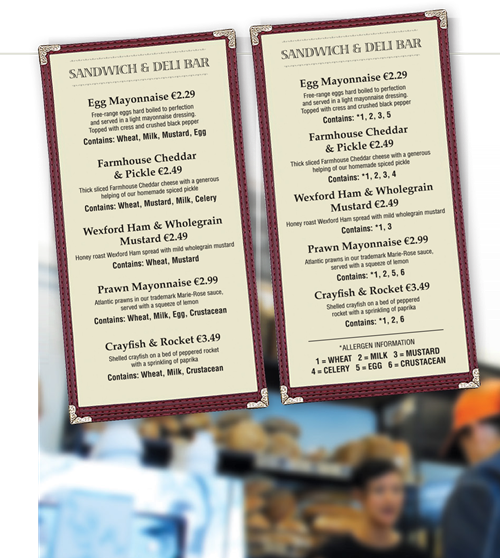
The format of allergen information may vary, but it must always be legible and easy to understand. Food businesses must ensure allergens are declared not only for main dishes but also for minor components such as sauces, condiments, and beverages (including wine by the glass, draught beer or cider, juices, and smoothies, where relevant).Where menu items such as “specials” are advertised separately from the main menu—for example, on chalkboards or similar displays—the allergen information must be updated each time the food offering changes.
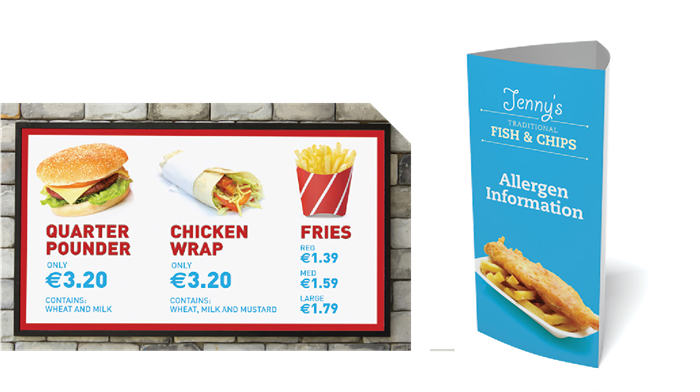
Hotels or other similar businesses offering room service can provide the written allergen information on individual menus available in the room (including drinks) or highlight on those menus or other documents where allergen information is centrally located in the establishment.
-
Food or food ingredients destined for mass caterers
Food allergen information as it relates to food or food ingredients destined for mass caterers can be placed on labels directly or in documents associated with the product. Caterers should ensure that they are in possession of such information for each food or food ingredient they purchase.


-
Contract catering
Contract caterers may operate in fixed locations where they can declare food allergens in the same way as restaurants. For off‑site functions—such as events held at a business premises or in a private home—caterers can provide the written allergen declarations at the location.
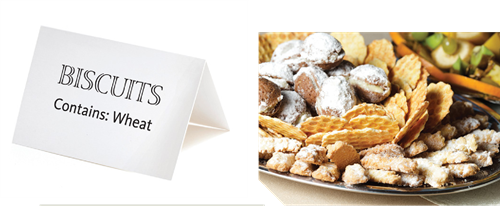
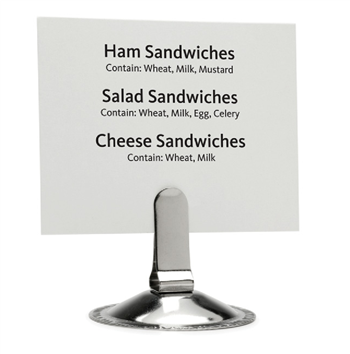
The requirement for written allergen information also applies to small‑scale food services, such as sandwiches, scones, or biscuits provided for meetings or gatherings. A stand‑alone sign placed beside a platter of mixed sandwiches is sufficient, as long as it lists the allergens for each sandwich type. The same approach can be used for platters of scones, pastries, or croissants. However, where a mixed plate of small snack foods such as biscuits is provided, the written allergen declaration may refer to the plate as a whole rather than to each individual biscuit type.
A caterer who delivers prepared food to a customer but has no further involvement—such as additional preparation or serving—must provide written allergen information to the purchaser. If the purchaser is a private individual and not a registered food business, it is their responsibility to pass that information on to the people consuming the food if they choose to do so. However, if the caterer is providing a service for a gathering or function and is preparing and serving the food at the event, it is the caterer’s responsibility to ensure written allergen information is available to the people consuming the food.
-
Food ordered remotely (electronically/by phone) and delivered to the consumer
Written food allergen information must be provided by food businesses engaged in ‘distance selling’. This includes businesses that take food orders by phone or electronically and deliver those foods to the final consumer.
Written allergen information may be provided before the food is ordered, for example through supporting material such as leaflets, catalogues, or online information used during the ordering process. It may also be provided at the time of delivery, such as through printed leaflets, catalogues, or other written material. Allergen information given at the point of delivery may relate specifically to the purchased product or may be provided as general supporting material.
Where written allergen information is supplied before delivery, allergen information must still be provided at the point of delivery. This may be given verbally or in written form.
Allergen information must be available before the purchase is concluded which could include supporting material that enables consumers to order a product.

-
Retail outlets
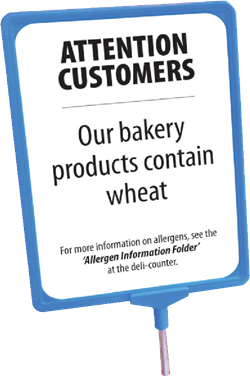
Shops and supermarkets—whether general or specialised—sell a wide range of non‑prepacked foods such as bread, salads, and hot food items. Written allergen information may be provided beside each individual food item or in a central location, similar to the approach used in restaurants and takeaways.
If the information is not placed directly beside the relevant food, it must still be easy for consumers to find and must clearly identify the allergens associated with each specific item. In large supermarkets, it is preferable to display written allergen information close to the non‑prepacked foods themselves. Where information is provided centrally instead, it should be available at one or more clearly marked locations, supported by prominent signage so consumers can identify it without difficulty.
-
Licensed premises
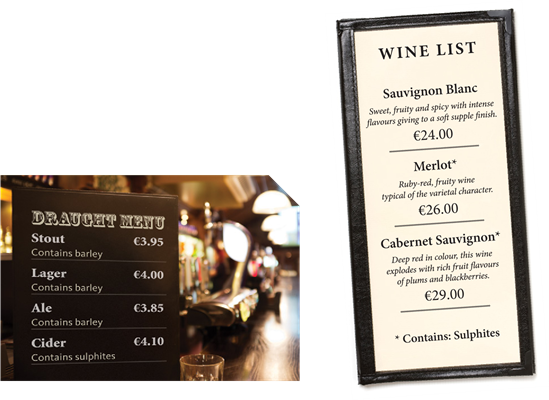
Written food allergen information already required for prepacked beverages (such as bottled or canned drinks) must also be provided for their non‑prepacked equivalents. This includes draught beer and cider, wine served by the glass, cocktails, smoothies, and juices.
Allergen declarations for non‑prepacked beverages may be provided in several ways. For example, wine lists may include sulphite information for specific wines, while allergen information for other beverages—such as cocktails—may be displayed beside the drinks or added to the price list in one or more conspicuous locations on the premises. The required allergen information must be presented using the wording “Contains…”.
Some cocktails or other mixed drinks may only be prepared in direct response to an individual request and may not be included in the regular drinks list. In such cases, it may not be feasible to provide written allergen information. However, any allergens present must still be communicated directly to the consumer before the sale is concluded.
-
Other food outlets, e.g. food stalls, markets
Permanent or temporary stalls or markets, whether stationary or mobile, must provide written food allergen information as a minimum requirement.
Because these facilities are generally small in scale, placing written allergen information close to the relevant food items or presenting it in a menu‑style format is usually the most convenient and effective approach. Centralised allergen information may also be used, provided it is easy for consumers to locate and clearly and legibly links each specific food item with its associated allergens.


-
Specialised businesses, institutions and organisations
There are exceptional situations where providing written food allergen information for non‑prepacked foods may require special arrangements. For example, written information may need to be supplemented by verbal communication relating to relevant food allergens in certain circumstances.
-
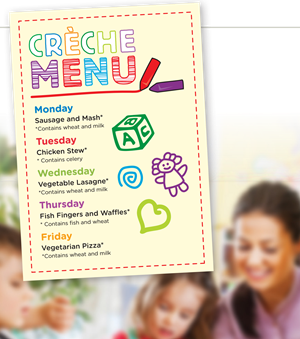
Childcare facilities Childcare facilities frequently prepare meals for the children in their care and are therefore required to provide written food allergen information. However, young children cannot understand or use this information, so it must be provided to the parent or guardian, particularly when new or altered menu items are introduced.
-
Healthcare facilities Healthcare facilities must provide written food allergen information to patients who eat their meals outside regular dining areas, such as in their room or ward. This is most effectively done by including allergen information on menus, although other written formats are acceptable. Where patients are unable to understand or use written allergen information, their carers or guardians should receive the written information on their behalf.
-
Detention centres Individuals in detention centres who cannot access general dining areas must be provided with written food allergen information, especially when new or altered menu items are offered.
-
Charitable organisations and free food provision The requirement to provide allergen information for non‑prepacked food applies equally to food that is sold or provided free of charge. Charitable institutions and other organisations offering food at no cost—whether at central locations or through home delivery—must provide written food allergen information. In central locations, this will be similar to the arrangements used in restaurants. In some situations, written information may need to be supplemented with verbal communication about relevant allergens.
-